


The permanent collections

The permanent collection were constitute by the Société d’Histoire et d’Archéologie Le Vieux Montmartre, created/founded in 1886 and recognized as a public benefit organization in 1967. Since 1960, its permanent collections are presented in the Musée de Montmartre and get benefits from the label Musée de France since 2003.
Over the years the Société constituted, primarily through donations, bequests, and deposits, a collection of more than 6000 works of art : paintings, sculptures, works of art, prints, and photographs depicting the artistic, religious, political, festive, and folkloric history of Montmartre. Artists such as Théophile-Alexandre Steinlen, Henri-Gabriel Ibels, Adolphe-Léon Willette, Eugène Delâtre, Henri de Toulouse-Lautrec, Marie Laurencin, Suzanne Valadon, and Maurice Utrillo attest to the quality of the collections.
These collections are supplemented by more than 100,000 archival items, focusing in particular on the history, artists, and daily life of Montmartre, as well as its dance halls and cabarets, including a truly remarkable collection dedicated to French chanson, a library of 3,000 books, and a wealth of documentation.
More about Le Vieux Montmartre ici
The creation of a new exhibition design made it possible to rethink the layout of the permanent collections in 2013: visitors can explore the history of the Butte, the artistic vibrancy of its studios from the Bateau-Lavoir to the Cortot studio and the atmosphere of its famous cabarets, from the Lapin Agile to the Moulin Rouge. One room, in particular, showcases Henri Rivière’s shadow theater that exceptional, dreamlike set made of zinc plates that made the Chat Noir cabaret famous. These collections immerse you in the history of Montmartre. During the 19th century, the landscape of Montmartre began to change, and it was incorporated into Paris in 1860: from then on, the city took precedence over the countryside. Artists began settling there starting in 1870. Cafés and cabarets proliferated in the 1880s. Soon, what would come to define Montmartre in the eyes of all was its vibrancy and creative energy. A new exhibition dedicated to the museum’s recent acquisitions—including works by André Utter and Maximilien Luce invites the public to explore this shared heritage that took shape around the Butte. | 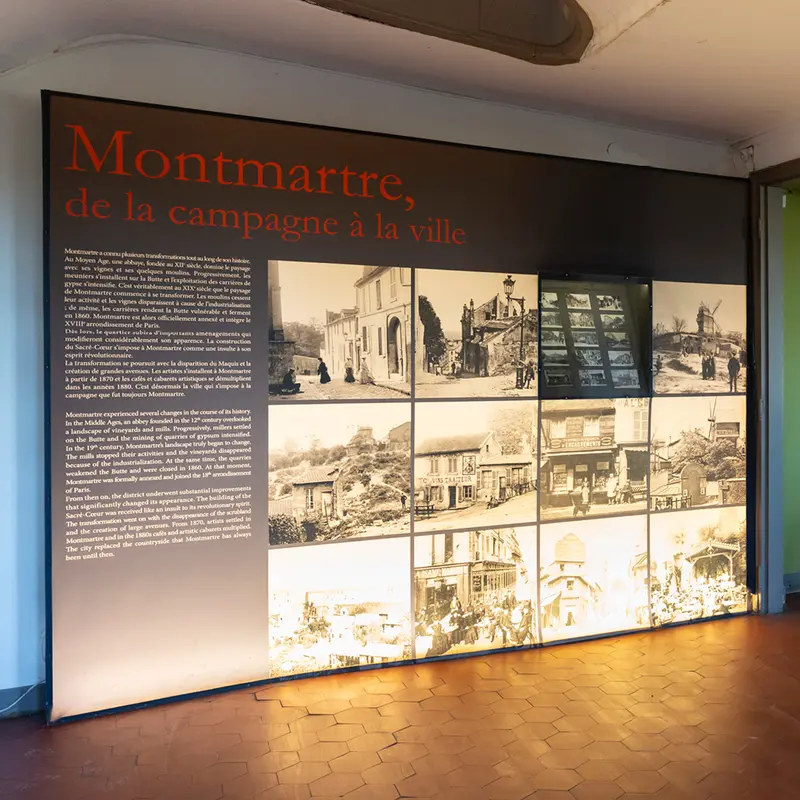 |
The mills in Montmartre
The mills and the millings make the legend of Montmartre, the nostalgia of a missing world. It’s no coincidence that the world's most famous cabaret took the name Moulin Rouge, even though the sails of the Montmartre windmills had not turned since the mid19th century.
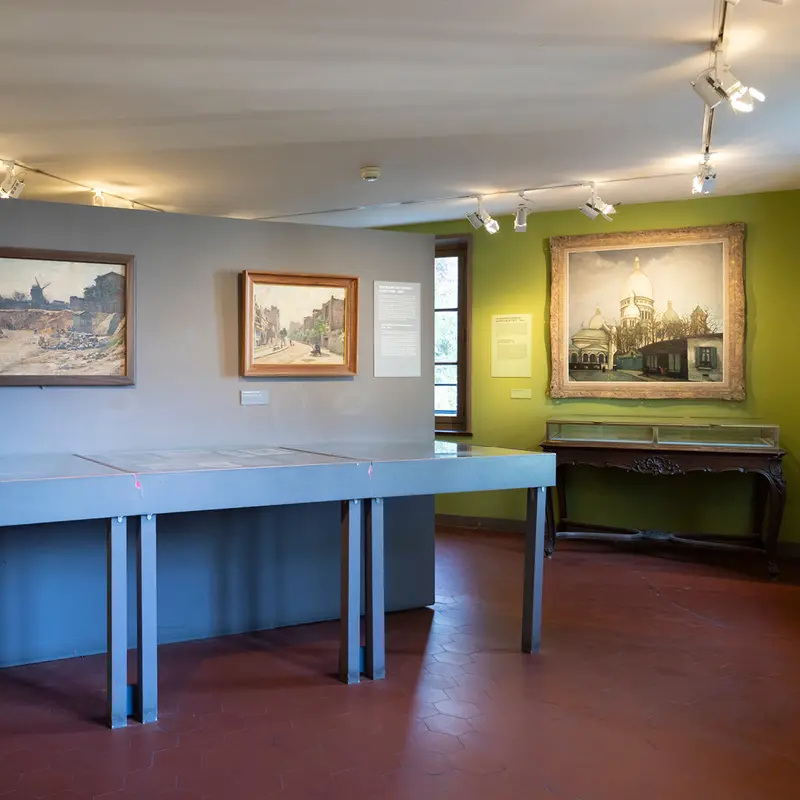 | In the past, there were as many as thirty windmills in the Montmartre area. Fourteen were located on the slopes of the Butte. The Moulin Vieux (1529), as its name suggests, was the first of them. On the hill of Montmartre, these windmills produced flour for Parisian bakers and ground plaster stones extracted from quarries, grapes from the vineyards, and various ingredients for paint merchants and perfumers. By the end of the 17th century, the expansion of vineyards contributed to the disappearance of land planted with grains, and the mills gradually adapted to new local activities, particularly the boom in plaster quarries, which were numerous in Montmartre during the 18th century. In the mid-19th century, the mills on the Butte ceased operations for several reasons. Victims of progress, urban expansion, and industrial development, most of the mills disappeared, such as the Moulin Vieux, which was abandoned around 1850, or the Moulin de la Lancette, which fell into ruin and was then demolished in 1836. Only the Moulin Radet and the Blute-Fin were preserved thanks to the ingenuity of their owner, who gave them a new lease on life by adapting them to a new purpose in 1870. The miller, Nicolas-Charles Debray, brought the two mills together and added a guinguette and a dance hall. |
Montmartre experienced several changes in the course of its history.
In the Middle Ages, an abbey founded in the 12th century overlooked a landscape of vineyards and mills. Progressively, millers settled on the Butte and the mining of quarries of gypsum intensified.
In the 19h century, Montmartre's landscape truly began to change.
The mills stopped their activities and the vineyards disappeared because of industrialization. At the same time, the quarries weakened the Butte and were closed in 1860. At that moment, Montmartre was formally annexed and joined the 18h arrondissement of Paris.
From then on, the district underwent substantial improvements that significantly changed its appearance. The building of the Sacré-Cœur was received like an insult to its revolutionary spirit.
The transformation went on with the disappearance of the scrubland and the creation of large avenues. From 1870, artists settled in Montmartre and in the 1880s cafés and artistic cabarets multiplied. The city replaced the countryside that Montmartre has always been until then.
The maquisThe Maquis area was an immense waste ground, which, in 1890, extended over the western side of the Butte: from the Moulin de la Galette to Rue Caulaincourt, between Rue Lepic and Rue Girardon. The Maquis mainly contained huts and makeshift shelters, between which ran a network of small earthen paths. This anarchic agglomeration was the result of the rapid colonisation of Montmartre after its annexation to Paris in 1860. Its inhabitants were as heteroclite and multicoloured as its buildings, and comprised all sorts of impoverished people: bohemian artists, ragmen, prostitutes, green-grocers, and all kinds of outsiders and rogues. Artists such as Poulbot, Paco Durio or Henri Laurens resided in cob cottages, surrounded with lilacs, mock oranges, laburnum and nett-les. « During his childhood, Jean Renoir liked to go there, looking for snails». Overlooked by windmills, such a landscape was to fascinate painters, such as Steinlen, Kupka, Maclet, Quizet or Leprin. But, quickly, the Maquis' fame became its demise, attracting real estate developers. Soon enough, its inhabitants had been expelled or expropriated. Finally, an arson destroyed the last shacks, allowing the construction of the Junot Avenue between 1909 and 1912. |
The commune (18th march - 28th may 1871)
Montmartre was the site of a major event in French history: the Commune. In September 1870, the defeat of Napoleon Ill's troops by Prussia led to the collapse of the Second Empire.
The Third Republic was proclaimed two days later and Gambetta formed a government of National Defence. However, on the 18th of September, the Prussian army surrounded Paris. The capital was put under siege for several months, starving the Parisions. In the face of the authorities' inability to restore institutional authority and the rejection of a treaty that was seen as humiliating, the Parisians rebelled and organised themselves into revolutionary clubs. The revolt spread and, on the 26th of March, the Commune was proclaimed in Montmartre. It was an unprecedented revolutionary event, during which very modern initiatives were introduced, such as the establishment of free, obligatory, secular schools, the separation of the Church and the State, equal salaries for men and women, the requisition of vacant housing, and citizenship for foreigners. The insurrection only lasted two months and came to an end during the Semaine sanglante 'Bloody Week' (21s to 28th of May 1871), when thousands of Commu-nards were killed. The surviving insurgents were brutally repressed. Louise Michel was one of these people. This schoolteacher, who was committed to revolutionary activities even before the Commune, presided over the Montmartre Women's Vigilance Committee, and during the Bloody Week she fought valiantly at barricades. |
The construction of avenue Junot (1909 - 1912)In 1860, Montmartre was officially annexed to Paris and integrated into the eighteenth arrondissement. Henceforth, the district underwent major urban developments that considerably modified its appearance. Altred Renaudin represented these transtormations in his paintings, particularly the disappearance of the Maquis when Avenue Junot was constructed between 1909 and 1912. This event completely altered the appeoronce of this part of the Butte: all the levels were altered and the Maquis area disappeare, in addition to the southern side of Impasse Girardon and the northern side of Impasse des Deux-Frères. Amongst the mansions that were then built on the avenue were those of Tristan Tzara, Jean-Gabriel Daragnes, Francisque Poulbot, Romain Delahalle, Suzanne Valadon, and Maurice Utrillo. The last constructions were completed around1930. |
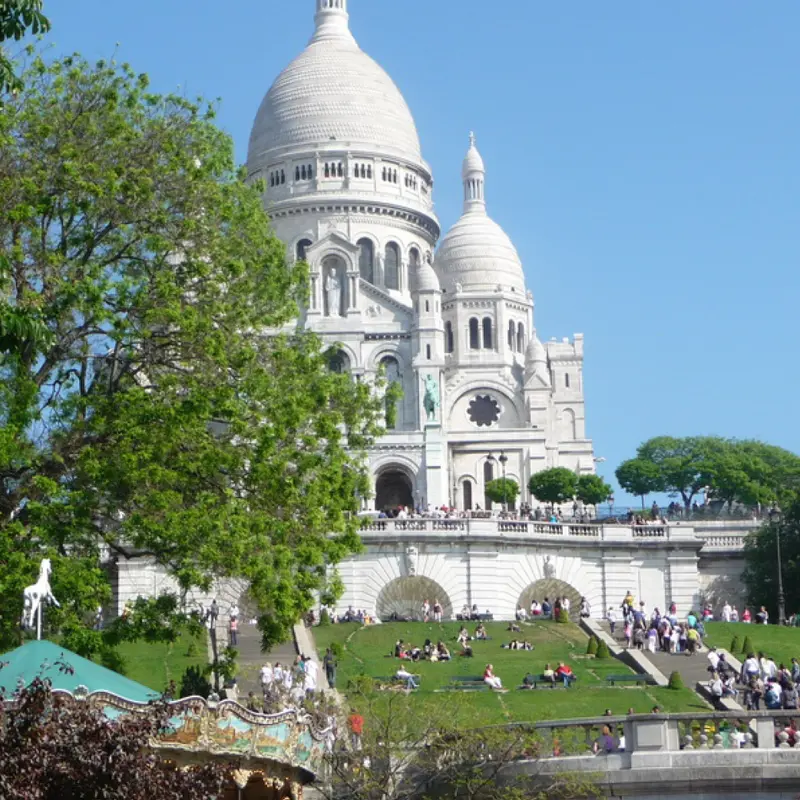 | The construction of Sacré-Coeur (1875 - 1919)On the 23th of July 1873, a law voted in the Assemblée Nationale decreed the construction of the Basilica of Sacré-Coeur. The archi-tect, Paul Abadie, who had studied under Viollet-le-Duc, won the competition with his design for Sacré-Coeur and was entrusted with its construction. He designed a church in the Romano-Byzantine style. The project necessitated six years of work and foundations had to be laid to consolidate the terrain that had been weakened by the old gypsum quorries (eighty-three concrete shafts, with a depth of thirty-eight metres, linked together by arches). The first stone was laid on the 16th of June 1875 and the basilica opened for worship in 1891. In 1900, the cupola was barely finished. The church was eventuolly consecrated in 1919 and completed in 1923. |
The Montmartre's abbey (1133 - 1790)
The Benedictine Abbey of Montmartre was founded by Louis VI and his wife Adélaïde de Savoie in 1133-1134.
Benefitting from the dual protection of the martyr of Paris, Saint Denis, and Saint Peter, the abbey had thirteen hectares of land enclosed by walls. The church, dedicated to Saint Peter, was embedded within the abbey. It was in the crypt of the Martyrium that Saint Ignatius of Loyola, who founded the Society of Jesus (commonly known as the Jesuits), is said to have taken his vows of chastity and poverty. During the Revolution, between 1790 and 1794, the monastery was destroyed, the land divided into plots, the property confiscated and sold at auction, and the bells were melted down. Marie Louise de Montmorency-Laval was the last abbess. The only vestige of this abbey is the church of Saint Peter, which was consecrated in 1147 by Pope Eugenius III. An example of pure Romanesque style, it is the oldest church in Paris-after that of Saint-Germain-des-Prés-that was spared during the Revolution. |
The quarriersDuring the first half of the 19th century, there were many quarries carved out of the hillsides. Gypsum was extracted from open-air quarries and subterranean galleries. The rock was then transformed into a very fine plaster in the many plaster kilns that existed round the Butte. Employed to make mouldings, plaster from Montmartre was widely used for the capital's buildings that it used to be said that there wasạmore of Montmartre in Paris, than Paris in Montmartre. The extensive exploitation of the quarries began to undermine the Butte, to such an extent that it was threatened with collapse. Consequently, as of 1860, the extractions gradually came to a halt and most of the quarries were consolidated. |
The first Chat Noir (1881 - 1885)
Billed as a « Louis-XIII style cabaret, founded by a fumiste, the first Chat Noir opened in November 1881 and was located at 84, boulevard Rochechouart, in an old post office.
In renovating the building, Salis participated in the popular practice in Paris of referring back to medieval or Renaissance France. At the Chat Noir, the Louis XIII-st le pseudo-Gothic furnishings were an expression of the growing nostalgia for Rabelesian France. For the interior, Eugène Grasset designed iron chandeliers; Adolphe Willette was responsible for the design of the cabaret's distinctive exterior sign: a black cat on a crescent moon. The cabaret as quite small. Its two narrow rooms, one behind the other, together barely held thirty people. Artists, writers, and musicians were the "habitués" of the place. n January 1882, Salis began promoting the cabaret with Le hat Noir journal: "The hat Noir is the most extraordinary cabaret in the worl. You ub shoulders with the most famous men of Paris, meeting there with foreigners from every country in the globe... It's the greatest success of the age! Come on in!! ome on in!. |
Ailleurs ! (“Elsewhere!”) Henri Rivière (1864 - 1951)
The Chat Noir's most important and renowned contribution was its formidable Shodow Theatre, created in 1886 by Henri Rivière ond Henry Somm. This sophisticate theatre of silhouettes used zinc plates and coloured lights.
The miniature stage featured a screen measuring approximately one square meter, with wings protruding from the rear of the building. The system involved placing silhouettes cut out of wood or zinc between a screen and a light source. Each scene could be brought to life using separate figurines. In the early days, a pianist improvised to accompany the scenes while Rodolphe Salis narrated the action. Later, improvisation gave way to a more structured script. The play *Ailleurs!*, subtitled “Revue Symbolique,” consisting of 20 scenes, premiered at the Théâtre du Chat Noir on November 11, 1891. It was the result of a collaboration between Henri Rivière (set design), Maurice Donnay (text), and Charles de Sivry (music). Two characters revisit the news of the past year during a fantastical journey: the “compère,” who is none other than Voltaire, represents the naive spectator; at his side, the “commère”—alias the poet Terminus, whose silhouette resembles that of Paul Verlaine—serves as the guide throughout this imaginary epic. The sets were restored in 2015 with support from the DRAC Ile-de-France. |
The postersThe artists of Montmartre played a key role in the production of posters at the end of the 19th and beginning of the 20th century. The recent techniques and reproduction processes provided artists a new form of creation and were not only a source of revenue, but also a way of disseminating their modernist aesthetics. Thanks to its effective spontaneous style, the posters were produced to advertise the various cabarets, concerts, and shows in Montmartre, and the journals, such as La Lanterne, books such as Guide de l'étranger à Montmartre The proliferation of posters in Paris encouraged commissions, and artists such as Steinlen, Grün, and Toulouse-Lautrec readily devoted themselves to this type of work. Jules Chéret had excelled in the art of colour lithography since 1866 and was considered the 'father of poster art' by the painters of Montmartre. The Nabi artists who lived in Montmartre, such as Pierre Bonnard, Maurice Denis, and Henri-Gabriel Ibels, turned these artistic techniques, considered to be minor, into a veritable art, thereby challenging the prevailing academicism. |
The Second Chat Noir (1885 - 1897)
Le Chat Noir, founded by Rodolphe Salis was the first vanguard literary, artistic and music cabaret in Paris.
In 1885, its growing success urged the cabaret to leave the boulevards to settle in a place built over three levels located on the rue Laval (currently Victor-Massé). At the entrance of this second Chat Noir, a sign exhorted the passers-by to be "modern"! Le Chat Noir was a place of innovation where evenings were made of a surprising mix of songs and patters, with the shadow theatre as main attraction. For the first time, o piano was authorized by the police. Pianists succeeded one another: Paul Delmet, Erik Satie, Claude Debussy and Gustave Charpentier also composed their music there. Le Chat Noir was most of all a meeting place for arts. Thinking of the Wagnerian dream about the "total artwork", Salis encouraged literary, artistic and musical collaboration in his cabaret. Le Chat Noir published a magazine, novels, organized the sale of paintings and brought artists like Auriol, Steinlen or Willette together with famous poets and musicians. Other artistic cabarets followed the example of Le Chat Noir, such as le Divan Japonais (the Japanese couch), L'Ane Rouge (the Red Donkey), the Café-concert of the Decadents or the Quat'z'Arts, in so doing contributing to write a next page in the history of the artistic avant-garde movement. |
The Chat Noir shadow theatre
The Shadow Theater, founded in 1886 by Henri Rivière and Henry Somm, became the element that best illustrated the Chat Noir’s credo that one must be “modern” above all else.
A la fin de 1887, avec la Tentation de Saint-Antoine, Rivière était parvenu à transformer un petit spectacle d'ombres en une production artistique extraordinairement technique et élaborée. Ces spectacles d'une complexité nouvelle possédaient en germe les caractéristiques essentielles de ce qui deviendrait le cinéma : le mouvement, la couleur et le son (musique et voix). Les pièces produites au Chat Noir pouvaient traiter de sujets incroyablement divers, allant de la geste napoléonienne telle que narrée dans L'Epopée (1886) de Caran d'Ache, à l'humour fumiste le plus débridé, comme dans Le Fils de l'eunuque (1888) de Somm, en passant par des œuvres mêlant réalisme et fantaisie avec La Tentation de Saint-Antoine de Rivière (1887), ou encore mettant à l'honneur le symbolisme le plus sérieux, par exemple dans le mystère religieux La Marche À l'Etoile (1890) de Rivière et Georges Fragerolle. Les productions élaborées par Rivière nécessitaient la collaboration de douze mécaniciens et de nombreux amis et confrères scénaristes, chanteurs, musiciens et assistants techniques. |
Others cabarets
Other artistic cabarets followed the example of the Chat Noir and proliferated in Montmortre in the 1880 ond 1890%: Le Divan Japonais (1883-1900), L'Ane Rouge (1890-1905), the Concert des Décadents (1893-1896), and the Cabaret des Quat'Z'Arts (1893-1914).
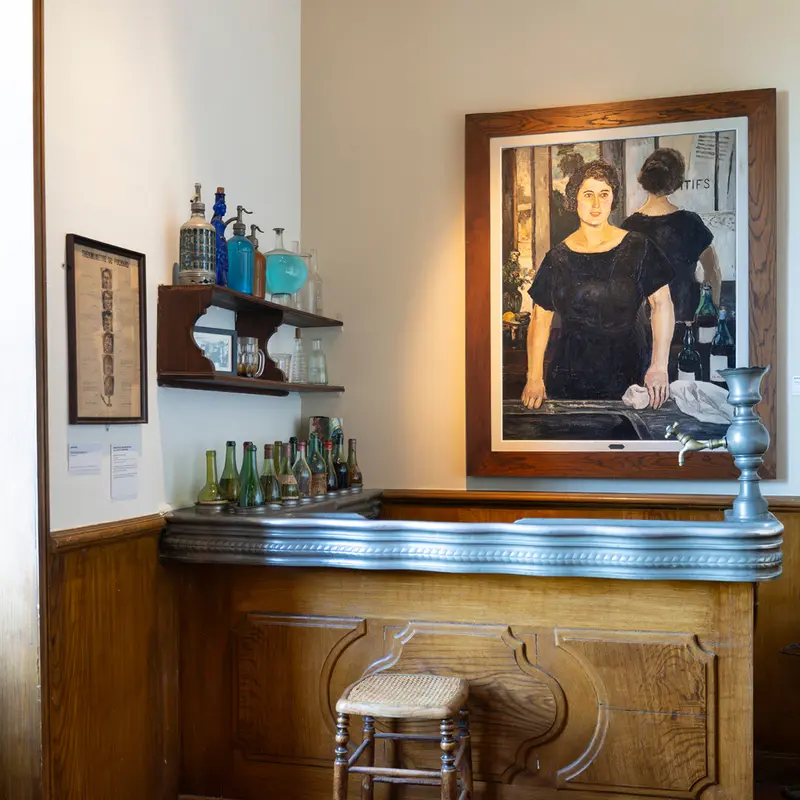 | Each of these cabarets has its own unique character: the Divan Japonais is steeped in Asian culture; the Concert des Décadents hosts exhibitions by fringe artists; the Cabaret des Quat'Z'Arts features a “wall-newspaper” where all forms of expression are permitted; and Le Mirliton attracts curious visitors eager to see the provocative singer-songwriter Aristide Bruant. But despite their unique characteristics, these various cabarets all take the famous Chat Noir as their model, maintaining its modern spirit and openness to innovation, creating—like the Chat Noir—revues where the arts coexist, and offering spaces conducive to artistic, literary, and musical encounters in an atmosphere of intellectual vibrancy and freedom. These cabarets were also often decorated by the artists who frequented them, such as Adolphe Léon Willette, Jules-Alexandre Grün, and Joseph Faverot. |
The artists who lived at 12-14 rue Cortot
Before becoming home to the Musée de Montmartre, the building at 12–14 Rue Cortot housed a complex of studios during the second half of the 19th century and the first half of the 20th century.
During this period, it was home to a succession of artists who are now considered major figures in the history of modern art: Pierre-Auguste Renoir, Maximilien Luce, Raoul Dufy, Othon Friesz, Charles Camoin, Émile Bernard, Francisque Poulbot, Démétrius Galanis, and even the “Infernal Trio” consisting of Suzanne Valadon, André Utter, and Maurice Utrillo. More than simply living there, they often depicted the premises or its gardens, which became subjects for their innovative formal experiments. As Montmartre emerged at the turn of the century as the new capital of the arts, these studios thus offered an ideal location right in the heart of this mecca of creativity. Many artists from all walks of life settled there, crossed paths, and exchanged ideas in an atmosphere of collaboration and mutual inspiration. The collection of works on display here showcases these illustrious residents, who turned these places into truly legendary studios. |
New acquisitions
The works from the Musée de Montmartre and the Weisman & Michel collection enter into dialogue around a shared artistic territory: Montmartre, a hub of experimentation and modernity at the turn of the 19th and 20th centuries.
Founded in 1886, the Le Vieux Montmartre Society of History and Archaeology has assembled an exceptional collection of more than 6,000 works of art and 100,000 archival documents. On display at the Musée de Montmartre since 1960, these collections—recognized as a “Musée de France” since 2003—are subject to a principle of inalienability that guarantees their preservation for future generations. They reflect an acquisition policy driven by the preservation of a shared heritage, in which each work is part of a collective memory. Alongside this institutional collection, the American collection assembled by David E. Weisman and Jacqueline E. Michel offers a complementary perspective. Assembled according to the couple’s personal tastes and sensibilities, it also fulfills an academic ambition: to bring together a coherent body of work capable of capturing artistic creation in Montmartre between 1880 and 1930. It thus presents a portrait of the golden age of the Butte, as captured by the artists who contributed to its fame. Brought together in an open dialogue between the museum’s collection and a private collection, these recently acquired works reflect distinct yet converging artistic journeys centered on Montmartre. The exhibition layout in this room, which is regularly updated, invites visitors to discover a story in the making, shaped by a variety of perspectives, blending heritage preservation with a passion for collecting. |
Practical information
- Open every day from 10am to 6pm
Last entry 45 minutes before the museum closes
- Admission rates : from €9 to €16
