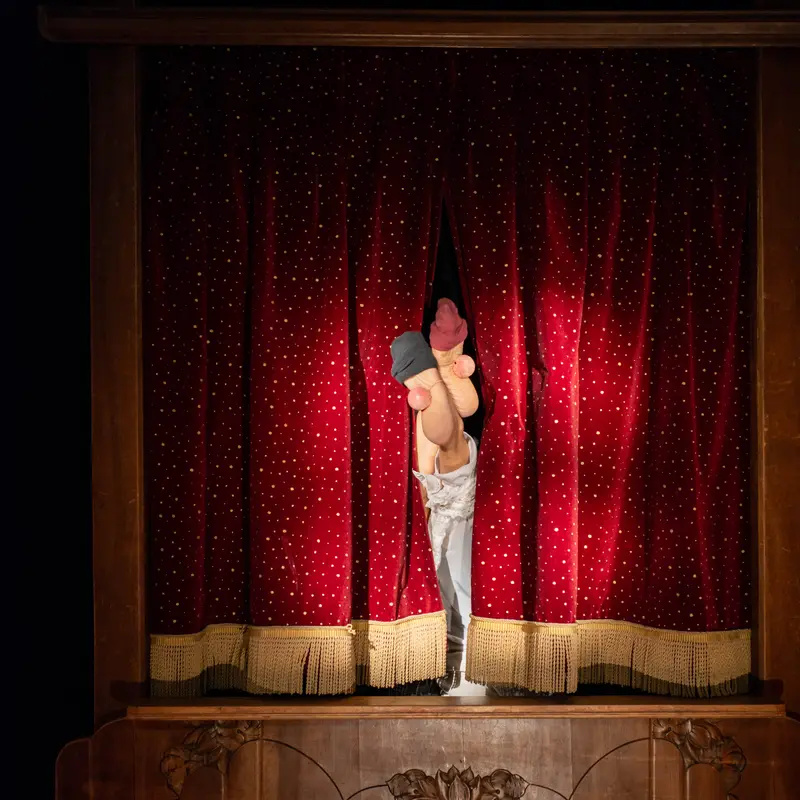
Now showing
16 October 2026 → 14 February 2027

For nearly a century, from 1873 to 1972, the circus made the heart of Montmartre beat faster. A few steps from the Bateau-Lavoir workshops, the Cirque Fernando, which later became the Cirque Medrano, is one of the highlights of Parisian life. Behind the prowess of acrobats, the brilliance of costumes and the magic of the track, generations of painters discover an unparalleled field of experimentation.
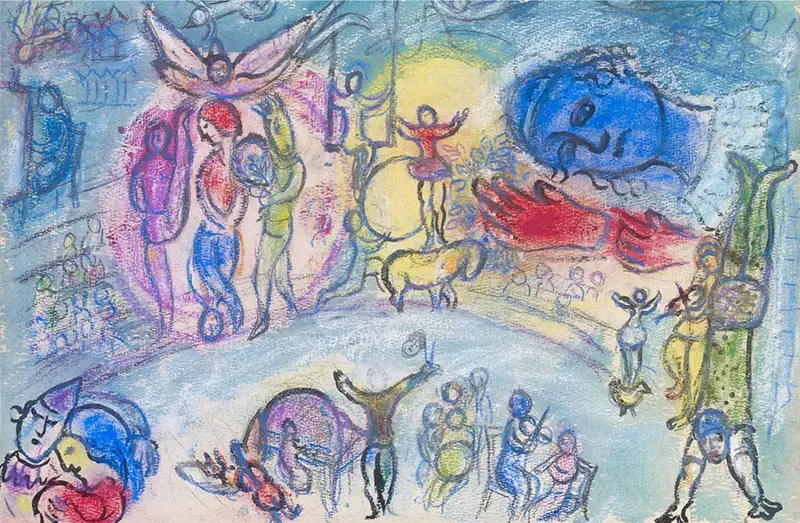 Marc Chagall, Esquisse pour Le Grand Cirque,circa 1956, pastel, lavis de gouache, encre de Chine et graphite sur papier vélin, 44,5 x 65,5 cm,coll. part. © Archives Marc &Ida Chagall - Paris, ADAGP, 2026 | Degas, Seurat, Toulouse-Lautrec, Picasso, Chagall, Rouault, Léger and many others find in it much more than entertainment: a space where new ways of looking at things, representing movement and thinking about modernity are invented. For a long time, the history of modern art has been built around artists' studios, theoretical manifestoes and the major aesthetic trends that have marked its evolution. The Musée de Montmartre invites you to explore another, more unexpected story: that of the circus as a crucible of creation. Through a chronological journey divided into four sections, the exhibition reveals how circus has helped to nourish the artists' imagination and shaped the great aesthetic changes of the 19th and 20th centuries. The sections follow one another in order to present to the visitor the popular atmosphere of the circus, its artists who have lived on the track but also those who have frequented its benches. These same artists who are now witnesses of the theatricality of the circus show and present the circus as a true reservoir of forms and figures, whose vitality continues to irrigate the artistic creation of the twentieth century. |
Through a chronological journey bringing together paintings, sculptures, drawings, posters, costumes and exceptional objects, the exhibition highlights the decisive role played by the circus in the development of plastic languages of modernity. In Montmartre, the Cirque Fernando, which became Cirque Medrano in 1897, is a true laboratory of new aesthetics where many artists from all walks of life meet, fascinated by the energy of the track and the figures who animate it. From the 1870s, Georges Seurat found in the circus a privileged subject of observation. Henri de Toulouse-Lautrec draws from it a constant inspiration before that Pablo Picasso, Fernand Léger, Marc Chagall or Georges Rouault seize in their turn this fascinating universe. The diffraction of light carried by the arrival of electricity, the movement of bodies, shimmering costumes and the circularity of the track nourish artistic research that fully participates in the rise of modern art. | 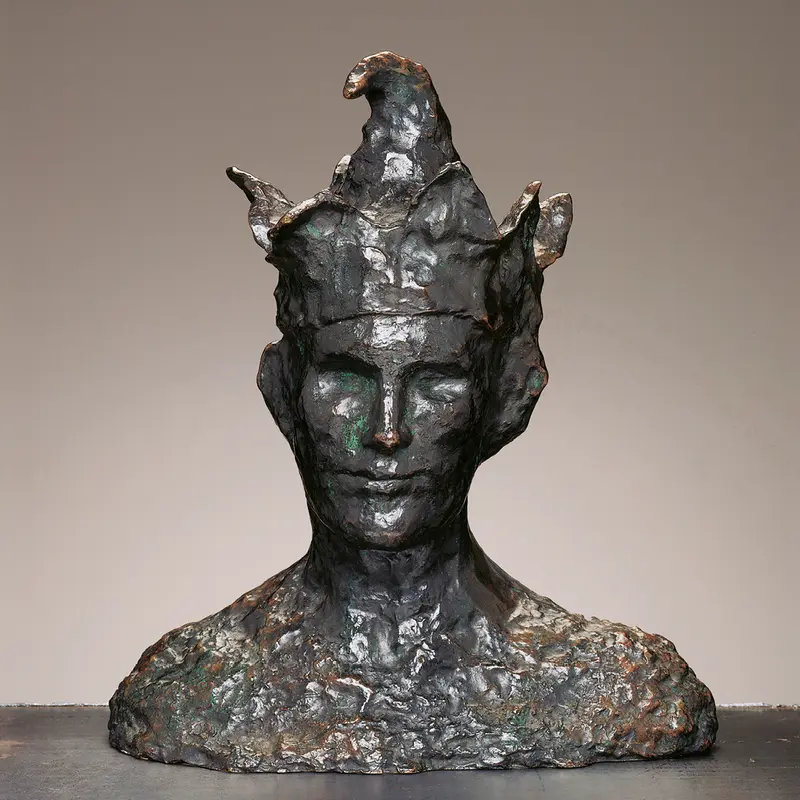 Pablo Picasso,Le fou, 1905, bronze,41,5 x 36,5 x 22 cm, Fondation Pierre Gianadda Martigny © Heinz Preisig |
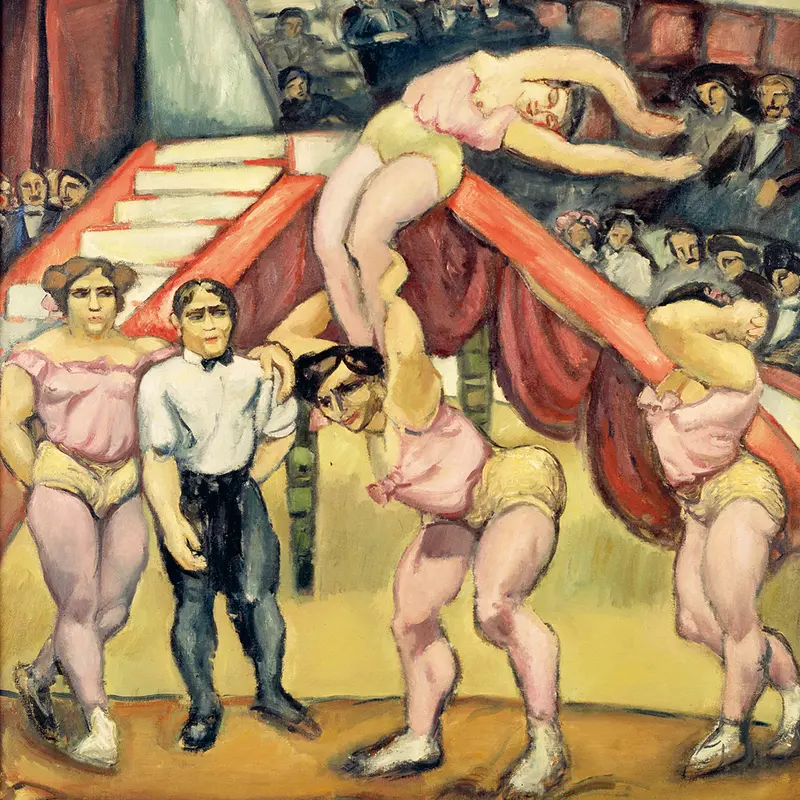 Othon Friesz, Les Acrobates, 1908, huile sur toile, Paris collection Larock-Granoff © Collection Larock-Granoff | Le cirque dépasse largement sa fonction de spectacle pour devenir un véritable lieu d’expérimentation artistique. Dans ce « pays des cercles en action », selon l’expression de Fernand Léger, les frontières entre spectacle et création s’effacent au profit d’un dialogue fécond entre les arts. Le saltimbanque devient une figure allégorique de l’artiste moderne, tandis que la piste elle-même semble préfigurer certaines des grandes révolutions esthétiques du XXe siècle. De la place de Clichy au boulevard Rochechouart, des baraques foraines à l’Hippodrome de Montmartre et au Cirque Medrano, c’est tout un territoire de spectacles et d’innovations qui accompagne l’émergence de nouvelles sensibilités artistiques. |
Indeed, it is a whole territory of performances and innovations that accompanies the emergence of new artistic sensibilities.Through this exhibition, the Musée de Montmartre pays tribute to an exceptional artistic and popular heritage. Thus revealing how, under the capitals of the Butte, an essential part of modern art was developed.
Practical information

- Full admission 16 €
- Reduced rate €10.50
- Free for children under 10
- Open every day from 10am to 6pm
Last entry 45 minutes before the museum closes
- From October 16, 2026 to February 14, 2027
Curator
Pascal Jacob, Marika Maymard, Gérard Borg and Jeanne-Yvonne Borg, collectors and specialists in circus arts
With the coordination of Alice S. Legé, doctor in art history and head of conservation at the Montmartre museum
In the press
"On the track in Montmartre!
Paris, end of the 19th century: the City of Light is endowed with new places of show and more particularly a circus, at the foot of the butte, boulevard Marguerite-de-Croischouart. For nearly a century, from Edgar Degas to Fernand Léger, all the artists of the avant-garde will then rush there, fascinated by the acrobats, horsemen, clowns and contortionists evolving in artificial light. A source of inspiration that survived until the 1950s and the gradual disappearance of circuses from the capital. The party is over." - S. Bl., Knowledge of the Arts, September 2026
Around the exhibition